Warnings
 | LATEST JOURNALS | |||||||||||
|
 ecently, speaking before an audience of Veterans of Foreign Wars, President Bush stated publicly, something which he had studiously avoided in the past; he made a direct comparison between the Vietnam war and the war in Iraq. He agreed that Vietnam holds
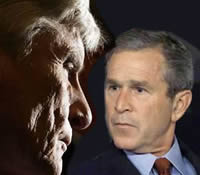 lessons for our policy in Iraq. As syndicated columnist Rosa Brooks puts it, following Bush's logic, our best move is to re-invade Vietnam". I think, that the lessons of Vietnam were pretty darned clear before he took us to war in Iraq and they become more and more true with the passage of time. As columnist Parks put it, "Don't fight needless wars, don't go blundering around in countries where you don't know the language, history or culture; don't underestimate the power of nationalism, ethnicity and religion to bind together - or tear apart - people whose interests otherwise seem to diverge or converge, and most of all, don't imagine that military force can solve fundamentally political problems".
To Mr. Bush and his thinker/advisors it would appear that the real tragedy of Vietnam is that we failed to let it drag on for more years and that the legacy of that benighted war was that the price for American withdrawal "was paid by millions of innocent citizens". Closer to the truth is that the momentous suffering was caused by the continuation of the war for so many years, rather than by the termination of the warfare.
Now the strongest Republican on the military, a man of vast experience, Senator John Warner has fired a shot across the president's bow and caught the White House off-guard. Just returning from his most recent foray into Iraq he has called on George W. Bush to commence a phased withdrawal from Iraq. Sen. Warner, a former Secretary of the Navy and WWII veteran, is the most influential Republican voice in Congress.
Mr. Warner, what will it take to get the president's attention? I'd add to that, what will it take to get the Iraqi people's attention, the attention of the bordering countries to enter and take a more active role in bringing about a reconciliation between the basic ethnic divisions within that country. To quote the Senator, "We simply cannot, as a nation, stand and put our troops at continuous risk of loss of life and limb without beginning to take some decisive action which will get everybody's attention."
Who actually lost Iraq? It will take a while for us to know, for sure, but that reckoning belongs to history.
Please, let's start bringing our troops home.
|
|
Michael
|
|
| |
||

| |
|
|
|
|
|
|
|
|
|
|
Michael Jackson Talk Radio
Official site of 2003 Radio Hall of Fame inductee,
7 time Emmy Award winning, 6 time Golden Mike Award winning, Talk Radio Host.
| visitors |
looking at Global Warming, Iraq, the Bush administration,
Corporate Criminals, the Economy and the up coming 2008 election.
Copyright © Michael Jackson 2007 all rights reserved.
http://www.michaeljacksontalkradio.com
Site Design, Hosting and Animation
Illuminary Arts